

Short answer: if the Modified Monash Model (MMM) rates your postcode and suburb as MM2 to MM7, you are classified as regional, rural or remote. MM1 is metropolitan. That classification is what determines whether the rural telehealth arrangements can apply to your psychiatry appointment. You can check your own address in about a minute using the government’s Health Workforce Locator — the steps are below.
How to check your Modified Monash Model rating by postcode
- Open the Department of Health’s Health Workforce Locator.
- Enter your address, or your suburb and postcode. Use the address where you will actually be during the appointment, not a postal address.
- Read the MMM classification returned for that location. If it is anything other than MM1, you are in a regional, rural or remote area for these purposes.
One postcode can span more than one classification, which is why the locator asks for a street address rather than just a postcode. If your result sits close to a boundary, it is worth checking the exact address rather than relying on the suburb.
The seven Modified Monash Model categories
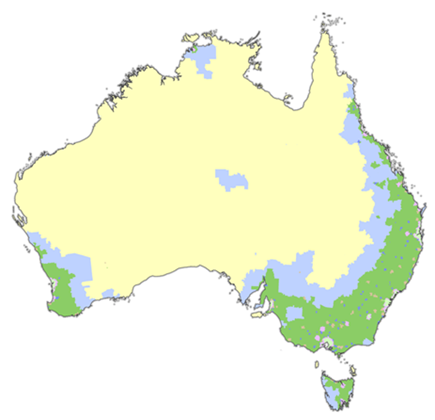
The MMM classifies locations from MM1 (major cities) through to MM7 (very remote), using the Australian Statistical Geography Standard remoteness areas (ASGS-RA) together with town population and drive distance.
| Category | Definition |
|---|---|
| MM1 | Metropolitan areas: major cities accounting for around 70% of Australia’s population. All areas categorised ASGS-RA1. |
| MM2 | Regional centres: Inner (ASGS-RA2) and Outer Regional (ASGS-RA3) areas in, or within a 20km drive of, a town with more than 50,000 residents. For example: Ballarat, Mackay, Toowoomba, Albury, Bunbury. |
| MM3 | Large rural towns: Inner and Outer Regional areas that are not MM2 and are in, or within a 15km drive of, a town of 15,000 to 50,000 residents. For example: Dubbo, Lismore, Yeppoon, Busselton. |
| MM4 | Medium rural towns: Inner and Outer Regional areas that are not MM2 or MM3 and are in, or within a 10km drive of, a town of 5,000 to 15,000 residents. For example: Port Augusta, Charters Towers, Moree. |
| MM5 | Small rural towns: all remaining Inner (ASGS-RA2) and Outer Regional (ASGS-RA3) areas. For example: Mount Buller, Moruya, Renmark, Condamine. |
| MM6 | Remote communities: remote mainland areas (ASGS-RA4) and remote islands less than 5km offshore, plus islands otherwise classified MM5 with a population under 1,000 and no bridge to the mainland. For example: Alice Springs, Port Hedland, Bruny Island. |
| MM7 | Very remote communities: very remote areas (ASGS-RA5), including remote islands more than 5km offshore. For example: Longreach, Coober Pedy, Thursday Island. |
What your classification means for a telehealth psychiatry appointment
Telehealth lets you see a FertilityPsych psychiatrist by video from wherever you are in Australia, which matters most for patients who would otherwise travel hours to reach a specialist. Medicare’s telehealth arrangements were broadened in March 2020 and rural and remote patients have specific provisions within them.
Patients located in MM2 to MM7 areas may be eligible for a bulk-billed psychiatry telehealth consultation where they have not had a psychiatrist appointment in the previous 12 months. Eligibility depends on the current Medicare Benefits Schedule rules, the item number billed and your individual circumstances, so our team will confirm what applies to you before your appointment rather than at the end of it.
A GP referral is required for any Medicare rebate. See referring to us for what your GP needs to include, and our fees for what an appointment costs where bulk billing does not apply.
Common questions
How do I find the Modified Monash Model rating for my postcode?
Enter your address in the Australian Government’s Health Workforce Locator. It returns the MMM classification for that exact location. A postcode can cover more than one classification, so use a street address where you can rather than the suburb alone.
What is the difference between MM1 and MM2 to MM7?
MM1 covers Australia’s major cities, which is roughly 70% of the population. MM2 through MM7 cover everything else, from regional centres such as Ballarat and Toowoomba down to very remote communities such as Coober Pedy. For rural health programs, MM1 is the metropolitan category and MM2 to MM7 are the regional, rural and remote categories.
Does a rural classification mean my appointment is free?
No. A rural or remote classification is one of several conditions that can make a bulk-billed telehealth consultation available, which would mean no out-of-pocket cost for that appointment. It is not automatic, and it does not apply to every appointment or every item number. Our team confirms what you will pay before you book.
I am in a capital city. Can I still see a FertilityPsych psychiatrist?
Yes. FertilityPsych sees patients across Australia by telehealth regardless of classification. The MMM rating affects which Medicare arrangements may apply, not whether you can be seen.
Does the Modified Monash Model change?
Yes. The classification is revised periodically as population and town data are updated, and a location’s category can move between revisions. Always check the Department of Health, Disability and Ageing source before relying on a category for a decision.
Useful sources
- Modified Monash Model — Department of Health, Disability and Ageing
- Health Workforce Locator — check a specific address
- About telehealth — Department of Health, Disability and Ageing
- Telehealth arrangements factsheet — MBS Online
Next steps
Learn more about our services and fees, read about accessing super for IVF, see how to claim your rebate, or contact us to get started.